(1)_edited.png)


APPEAL APPL-26-0004 · CITY FILE DEPN-26-0039
A 100-megawatt data center was approved next to 200 homes.
No hearing. No vote. Eighty-six days.
It was approved by one planner's electronic stamp on June 11, 2026, at 3:25 in the afternoon. Thirty-four residents appealed. City Council hears that appeal on September 17.

WHAT THE CITY APPROVED ON JUNE 11
Sheet M201 of the approved plan set, stamped by the City at 3:25:15 p.m. on June 11, 2026:
72
CHILLERS
60
GENERATORS
100
MEGAWATTS
368
FEET TO HOMES
The applicant says that sheet was an error, and offered a replacement.
Sheet M201 of the approved development plan does contain information depicting a 'MOD-1 DATA HALL (50 MW)' and 'MOD-2 DATA HALL (50 MW)', which certainly does give the appearance of a phased buildout… it has been decided that the administrative record will not be revised as it would be interpreted as a subsequent plan modification, which would impact each of the appeals."
— Daniel Sexton, Planning Manager, City of Colorado Springs, July 1, 2026

WHAT IT MEANS WHERE YOU LIVE: THE SOUND
Seventy-two chillers and sixty diesel generators produce most of their sound at low frequency — the deep, carrying kind that travels furthest and passes through walls.
A Planning Commissioner asked the Director of City Planning whether the City had asked its own acoustic reviewer to examine it.
"That's correct. We didn't ask for that because there's no way for us to do anything about it even if we know it."
— Kevin Walker, Director of City Planning, July 23, 2026
He had already agreed the City's noise code "does not specify those lower limit sounds." Asked whether it could be monitored on the C-weighted scale, which does capture it, he said: "So it could be monitored. But again, it's just a piece of information."
The City did commission an independent check. It hired an acoustic consultant to peer review the applicant's noise study. That review is the only independent assessment of sound anywhere in this record.
May 14, 2026 — The consultant returns the study with seventeen critical annotations. Among them:
"This data needs to be provided!… a reviewer such as myself has no idea what they are doing."
"If the rest of the report had similarly detailed information I could independently audit this analysis."
June 1 — Eighteen days later, he issues a two-page memorandum. The City treats it as clearance. That memorandum records what he modelled: "34 chillers running at 75% and no generators," and in a second run "five of 30 generators." It used the layout in the April 22 submittal, superseded on May 27. The approved plan shows 72 chillers and 60 generators.
June 11 — The application is approved.
June 15 — The City's memorandum states: "The consultant confirmed that the report accurately identified the project's noise sources and applied appropriate mitigation measures." He never modelled the equipment on the approved plan, and never said he had. Neither the consultant nor the City has ever produced a noise model of 72 chillers and 60 generators. The same memorandum says the consultant "advised City staff that scientific research on infrasound and low-frequency sound remains limited, and that no consistent regulatory framework exists nationwide to address these issues." What he actually wrote, on the applicant's treatment of infrasound, was: "I agree with this, but there is no rigor to this text. It is just their opinion. I have testified on the infrasound issue countless times in the company of medical doctors and by referencing peer reviewed medical studies. Some of that rigor should be brought to bear here."
LISTEN TO IT:
REED R8060 sound level meter, July 2026.
.png)
.png)
Project Taurus modelled levels. DLAA rev C, May 29, 2026, p. 15.
The approved plan describes its sound wall in two numbers only — a Sound Transmission Class rating and a Noise Reduction Coefficient rating. Sound Transmission Class is measured from 125 hertz upward. Noise Reduction Coefficient averages four bands beginning at 250 hertz. The sound at issue sits below both.
.png)
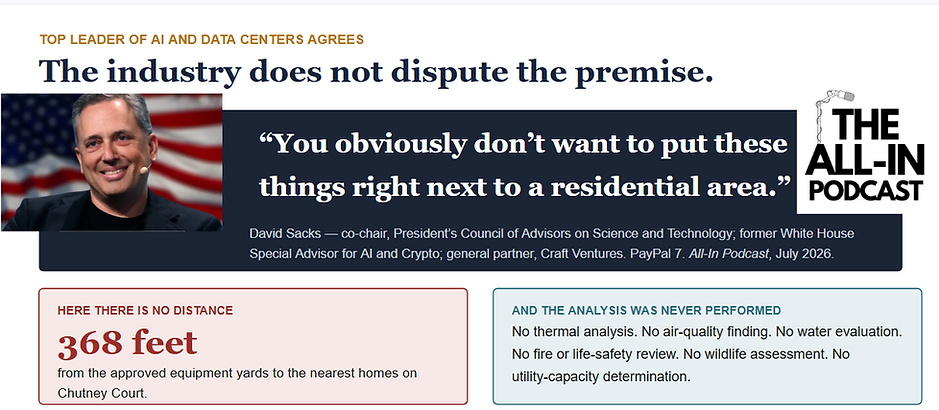
All-In Podcast, :Can the AI Industry Regulate Itself? Stripe Wants Paypal, China Catches Up, NY Bans Data Centerrs." July 2026
WHAT THE RESEARCH SAYS:
The applicant's own acoustician, under questioning by the Planning Commission:
Commissioner Willoughby: "…your report predicted the audible environment in the 20–63 Hz range, and it didn't do an analysis on anything lower than that because that wasn't a requirement that you needed to meet. Is that a fair statement?"
"Correct. The noise study was from 63 Hz up to… 4 kHz or 8 kHz because the noise code is written in terms of dBA. If the noise code had been written in some other standard, we would have looked at other areas of the spectrum."
— Scott Petrovits, D.L. Adams Associates · 10:17:30
"There is some good data showing a possible link between low frequency mechanical noise and human health… I think it might definitely help highlight the relationship between low frequency mechanical noise and human health."
— Scott Petrovits · 10:18:20
City Planning Commission hearing, July 23, 2026.
The peer-reviewed literature:
Baliatsas C., van Kamp I., van Poll R. & Yzermans J., "Health effects from low-frequency noise and infrasound in the general population: Is it time to listen? A systematic review of observational studies," Science of the Total Environment 557–558 (2016) 163–169.
A systematic review of seven observational studies, 2000–2015. Findings: "A part of the population reports high annoyance attributed to LFN sources… LFN is associated with self-reported outcomes, mainly neurological."
Pawlaczyk-Łuszczyńska M. et al.,
"Impact of infrasound and low frequency noise on human health and well-being. Part I: Review of experimental studies," Medycyna Pracy 74(4):317–32 (2023).
THE CODE HAS NO SETBACK FOR THIS
The approved plan describes its sound wall in two numbers only — a Sound Transmission Class rating and a Noise Reduction Coefficient rating. Sound Transmission Class is measured from 125 hertz upward. Noise Reduction Coefficient averages four bands beginning at 250 hertz. The sound at issue sits below both.

A gas station needs 250 feet. A kennel needs 55. A hundred-megawatt data center with sixty diesel generators needs a landscape buffer. Nothing in the record shows the buffer standard was applied, or that any setback analysis was performed at all.
City of Colorado Springs Unified Development Code § 7.3.303
Virginia's legislative audit commission found in 2024 that almost a third of that state's data centers sit within 200 feet of residentially zoned property — because zoning ordinances there treat data centers in the same category as office space.
WHO LIVES HERE
Chelsea Glen is about two hundred homes. As one appellant told the Planning Commission, it is "the home of many people that serve the city. Teachers, police, fire." Her husband served the Colorado Springs Fire Department for thirty-two years. It represents the heartbeat of our city.
One appellant is a one hundred percent disabled Army Special Forces veteran, housebound, with a service dog. The City has his file. Nobody contacted him about accommodations.

HOW IT WAS APPROVED IN EIGHTY-SIX DAYS
JAN 13
Rapid Response Certificate
MAR 17
Application Filed
JUN 11
Approved, 3:25 p.m.
JUL 23
Appeals Denied
SEP 17
City Council

City of Colorado Springs Economic Development Division, January 13, 2026.
It designates Project Taurus "an official Rapid Response Project — qualified to receive expedited plan reviews." It is laid out like a certificate of achievement, with a border and a signature line.
The City certified this project for expedited review two months before it saw the application. The officer who signed it is the same officer the applicant's lobbyist named in April: "I have spoken with City Economic Development (Jesse Kimber) and they and the CS Chamber are very supportive."
HOW IT WAS APPROVED IN EIGHTY-SIX DAYS
.png)
Released by the Mayor's Office, August 14, 2026.
On August 14, 2026 the Mayor released six Community-First Data Center Standards. His office says they respond to the July 23 Planning Commission hearing on this project, where residents raised noise and neighborhood impacts, water and electricity use, utility rates and infrastructure, emissions, and the location of these facilities near homes.
Measured against them, Project Taurus fails all six.
Six headings, and every one begins "WE WILL." We will protect ratepayers. We will protect our water. We will protect our neighborhoods. We will protect our community standards. We will welcome community contribution. We will protect the public's voice.
Then read the text underneath. Projects "may be required" to demonstrate water availability. The City "may require" independent technical studies.
The promises are declarative. The requirements are discretionary. And every verb points forward, at applications not yet filed.
The release says these standards answer a clear call for greater transparency and enforceable standards. A standard that reaches only future applications is not enforceable against the one that prompted it.
Project Taurus was approved on June 11 by a planner's electronic stamp at 3:25 in the afternoon, with no public hearing.
The standards were written on August 14.
The appeal is heard on September 17.
Either they apply to it — in which case Council must reverse — or the City has announced protections that exempt the one project that prompted them.
The line across the top of the Mayor's own graphic reads: "Protecting our community. Preserving our future."
Protecting a community means applying the standards to the project in front of you.
WHO WAS IN THE ROOM
Every quotation below comes from records the City of Colorado Springs and Colorado Springs Utilities produced to appellants under the Colorado Open Records Act. Each source is linked.
PART 1 · THE CITY'S OWN LOBBYIST TOOK THE APPLICANT AS A CLIENT, CORA #53292
Brownstein Hyatt Farber Schreck holds the City's General Assembly lobbying contract. Signed November 9, 2020 at $84,000, it has been extended six times to $1,137,000. n April 2026 the firm asked the City for permission to act for Raeden. Between May 2025 and May 2026 the City paid $253,500 on twenty-seven invoices. Each one is a single line: "Monthly Retainer."
WHAT HE TOLD HIS OWN FIRM · APRIL 21, 2026
"From a zoning and utility perspective it's an ideal situation. Despite public opposition for all kinds of bizarre reasons it will almost certainly be approved administratively… They are also hiring our firm for PR assistance and want to retain me to attend various public meetings and help secure support from various governmental and community leaders. I have spoken with City Economic Development (Jesse Kimber) and they and the CS Chamber are very supportive."
— John Suthers, former Mayor of Colorado Springs
Seven weeks before the approval. It predicts the outcome. And he had already spoken to City Economic Development — a week before the City granted the waiver. His colleague replied: "Sounds like a plan and a great project!"
THE FIRM'S OWN STAFF FLAGGED IT · THE SAME DAY
"...this is actually lobbying since we're trying to convince the City to support their issues…The City of Colorado Springs is a client so we need to get waivers here."
— Laura Seidl, Conflicts and Intake Director
"That seems like lobbying, and also if the City is a client, like a conflict."
— Katrin Rothgery, General Counsel
THE WAIVER THE FIRM DREW UP
"Raeden desires to engage us for lobbying matters… in which the City is involved as an adverse party… We recommend that the City seek independent counsel regarding the effect of this waiver."
APRIL 24 · THE ACTING CITY ATTORNEY
"I do want to make you aware of City Council Rule 6-2(B)…"
SUTHERS' REPLY
"We have always understood a matter becomes quasi-judicial when there is a filing of an appeal that means it will go to the council."
The firm's own test. The appeal period closed June 22. Everything in Part 4 is after that.
The waiver was granted in three days.
Source: Conflict waiver correspondence produced by the City of Colorado Springs, CORA #53292, Contract C010146 and Modifications 001–006, produced August 14, 2026, Invoices, May 2025 – May 2026
FIVE WEEKS EARLIER
On March 3, 2026 Brownstein hosted a fundraiser for the Mayor at its Colorado Springs office. Nine of the firm's attorneys sat on the host committee, including the applicant's counsel. Host levels were $1,000 and $500.

PART 2 · THE CITY HELPED THE APPLICANT PREPARE FOR THE PUBLIC MEETING
On May 13, 2026 — nine days before the public forum, and four weeks before the approval — the Colorado Springs Chamber & EDC convened a meeting titled "Project Taurus Practice for Open Forum," with a "DRAFT Run-of-Show" attached.
On the invitation, among others:

The follow-up email the next day: "Thanks for the great pre-meeting yesterday. Attached are Jason's slides to open the event and the updated run of show with John Suther's opening remarks."
The public forum was held on May 14. The Chamber's own recap records that Mr Suthers moderated it.
Colorado Springs Utilities records production, CORA W002023, pp. 45–46 and 153–154
PART 3 · THE CITY HELPED THE APPLICANT PREPARE FOR THE PUBLIC MEETING

On June 2, 2026 at 11:58 a.m., the chief executive of the Colorado Springs Chamber & EDC emailed her economic development staff, marked Importance: High. Subject: "Invite for Kissing Camels HOA to meet with Raeden about proposed Data Center — Need Quick Help With Invites."
"Titans of ED Council — Need your help with a quick turnaround invite. We have just confirmed a meeting for tomorrow night… for residents of Kissing Camels neighborhood with Jason Green, CEO and Co-Founder, of Raeden."
"This meeting is not open to the public or the media."
At 12:34 p.m. the invitation was forwarded inside Colorado Springs Utilities to six staff, including the Chief Executive Officer, marked Importance: High. It was forwarded twice more that afternoon — by the Chief Human Resources Officer, and by the General Manager for Regulatory, Environmental and Public Affairs, whose covering note read: "fyi - no action necessary." Each forward carried the "Project Taurus OnePager." Twelve Utilities employees had it before the end of the day.
.png)
The Chief Executive Officer of CSU sent his at 2:55 p.m., to Tim Leigh — a Kissing Camels resident, a commercial real estate broker, and a former Colorado Springs City Councilman who sat on the Utilities Board, as councilmembers do. He served alongside Scott Hente, then Council President and now president of the Kissing Camels homeowners association — the "HOA president" the Chamber's email says "agreed to a meeting this week."
Seven weeks later, he addressed the Planning Commission. He opened: "Kevin, good to see you up there."
"I'm a former Colorado Springs City Councilor, former member of the board of utilities, 40 years as a commercial real estate broker in the city." On the objections — power, water, wastewater, noise, environment — "the record is answered clearly on all those issues." And: "this is not a real problem. It's just loud."
PART 4 · THE APPLICANT HELPED SHAPE THE HEARING
The appeal period closed on June 22, 2026. By the firm's own test, the matter was quasi-judicial from that moment. Everything below happened after it.
JUNE 26 · 12:17 A.M.
The applicant's counsel sends the City a proposed agenda for the appeal hearing. Among the items:
"Standard of Review — limit the hearing to matters raised on appeal"
"Appellants (combined? together?)"
"Is City confirming each appeal meets the Code requirement of property owner or tenant within 1000 feet…"
"Public Comment — request name and address so PC knows if resident?"
JUNE 26 · 12:12 P.M. — twelve hours later
The Director of City Planning sends her the draft "Ground Rules and Procedures" for the hearing. Filename: "DJS 6.17.2026.docx." The applicant's lobbyist and planning consultant are copied.
JUNE 26 · 1:45 P.M.
"I should have asked in our meeting, but for future communications out to Jason and team will you please CC me too?"
JUNE 29 AND JULY 6
She asks the City which witnesses it will produce: "We would appreciate if Abby Ortega with Colorado Springs Utilities could attend on July 23 and speak to both those issues directly." The City confirmed. Colorado Springs Utilities attended.
On July 6 she asks whether the City's third-party sound reviewer will attend. He did not.
JULY 2 · THE PLANNING COMMISSION WORK SESSION
Staff told the Commissioners that the hearing information "has not been shared with the appellants and applicants yet," and would be shared "post this meeting."
It had been sent to the applicant six days earlier.
Two Commissioners conditioned their agreement on consulting the appellants. Neither was told that consultation with the applicant had already happened. At the same session the Chair told the Commission "we're not reading the original criteria" and that "we're not applying the criteria like we would." The City's own work-session slide identified the approval criteria as Code Section 7.5.516.D.1.
Appellants have asked for that instruction in writing seven times. It has never been produced.
Source: City of Colorado Springs records production
WHAT WE ASKED FOR AND DIDN'T GET
Almost everything on this page came from records the City and Colorado Springs Utilities produced under the Colorado Open Records Act. Getting them took forty-three records requests to the City and ten to Colorado Springs Utilities, at a cost of $1,113.24 in fees.
WE ASKED SEVEN TIMES FOR ONE DOCUMENT
On July 2 the Planning Commission was given an instruction about how it would hear these appeals — that it was "not reading the original criteria." Appellants asked for that instruction in writing the same day.

The correspondence: [July 8 consolidated letter] · [July 17 renewal] · [Objection Packet, filed July 23]
The Planning Commission hearing was held on July 23. The instruction has still not been produced.
AND SOME THINGS THE CITY SAYS IT DOESN'T HAVE
We asked for the City Council minutes of August 8, 1995. The City told us to find them on its website. We obtained them from the bound volume at Penrose Library.
We asked twice for the conditions attached to that 1995 approval. The City produced no record. The four conditions were in the Council agenda packet in the City Clerk's own online portal the whole time. The City's June 15 memorandum told the decision-maker that prior land use approvals "did not contain any conditions of approval."
We asked for two 1985 development plan files. The City replied: "A search of City files located no records responsive to your request." Three weeks later it produced its own Planning Commission minutes describing both files — by number, applicant, acreage, zone, planner and approval date.
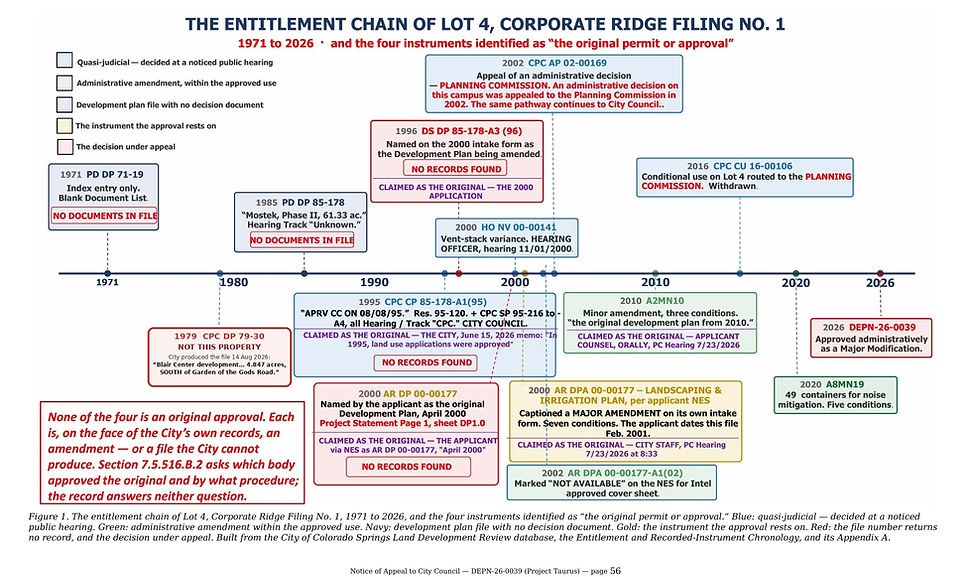
Four different instruments have been identified as the original development plan this modification amends — one by the City, two by the applicant's side, and one by the 2000 application form itself. They do not agree. The City cannot produce two of them.
The firm that told the Planning Commission the original was "the development plan from 2010" is the same firm the City pays $1,137,000 to represent it in lobbying matters. Its two clients have given different answers to the same question.
THEY CANNOT NAME THE ORIGINAL, OR WHO APPROVED IT
Section 7.5.516.B.2 of the City's code: a Major Modification "may only be approved by the decision-making body that approved the original permit or approval, using the same procedure used for the original permit or approval."
The provision uses the singular twice. It has one answer.
The City has never identified the original permit or approval, the body that approved it, or the procedure used.
Appellants requested the record of that determination on June 18, 2026. It has not been produced.
Four different instruments have been identified as that answer — one by the City, two by the applicant's side, and one by the 2000 application form itself. They do not agree with each other. The City cannot produce two of them.
None of the four is an original approval. Each is, on the face of the City's own records, an amendment — or a file the City cannot produce.
The firm that told the Planning Commission the original was "the development plan from 2010" is the same firm the City pays $1,137,000 to represent it in lobbying matters. Its two clients, the City and Raeden, have given different answers to the same question.

From the Notice of Appeal to City Council, page 11.
The chain runs from 1971. Every plat, variance, concept-plan amendment and conditional use in it that reached a hearing body appears on the City Council agenda of its day captioned "(Quasi-Judicial Matter)."
.jpg)
AND THE USE ITSELF
The applicant's attorney told the Planning Commission that the property "has been designated as a data center for the last 16 years," and said three separate times that "the modification does not change the use of the property."
She also told the Commission: "the data center is defined as a light industry use in your code."
There was no data center use in the City's code at all until October 1, 2012.
That day the Council adopted Ordinances 12-65 and 12-66, nine votes to nothing. The first inserted the definition among the Commercial use types. The second put "Data Center" into the permitted-use tables and set its parking at one space per 400 square feet of office.
It was not reclassified as light industry until Ordinance 23-03, February 14, 2023.
Sixteen years before July 2026 is 2010. There was no data center category in the Code to be designated as until 2012.
Every approved plan in this chain describes office and manufacturing. The recorded covenants for this property say it "shall be used for the office, warehouse and manufacturing uses."
A computer room inside a semiconductor plant is not a data center, any more than a kitchen inside a house makes it a restaurant.
The City's own approval letter of June 11 says this modification "establishes a data center use in the existing industrial building." So does its June 15 memorandum. So does the agenda item that opened the appeal hearing.
The applicant's counsel says the use does not change. The City says the approval establishes it. Both cannot be true — and either answer defeats the approval.
If it establishes a use not included in the approval being modified, Section 7.5.516.C.1.e makes it a Major Modification, and Section 7.5.516.B.2 confines it to the body that approved the original — which the City has never identified.
If it does not establish a use, the City's own decision document is wrong on its face.
WHAT APPELLANTS' COUNSEL TOLD THE COMMISSION
"Raeden's counsel said that it's my burden. She's mistaken. This is administrative review. This is a quasi-judicial decision. The standard is what the code says. It's not what a reviewing court would apply later. You are the experts at the application of your code.
The burden is backwards. The applicant sought a discretionary approval. It was the applicant's obligation to put before the decision maker a record supporting every finding the code requires.
What the applicant put before him was a plan set stating 72 chillers and 100 megawatts — but studies analyzing 36 chillers and 50.
That is not appellants failing to prove an error. That is the applicant failing to establish an entitlement."
— Katherine Gayle, appellants' counsel & Chief Legal Counsel, Integrity Matters, City Planning Commission hearing, July 23, 2026
On the noise study, she told the Commission: "They never modeled the 72 chillers on the approved sheet. Neither did anyone else at any load in any scenario."
And on the criterion the City never reached: "Section 7.5.409, which is the public health, safety and welfare, was completely omitted. We cannot address the validity of a fact that was never even considered."
"We're not asking you to decide what anyone intended. We're telling you the record does not establish what was approved."
WHAT THE CITY NEVER ANALYSED
The City's own Planning Manager told the Commission that staff "did have to kind of flex the guardrails of what code allows" on environmental, air quality and heat-island impacts, "because there's not very clear regulatory parameters in code today."
Here is what that meant in practice.
No comparison. Section 7.5.516.D.1.c required the City to compare this modification's impacts against the impacts of the use as previously approved. The City wrote "meets current standards" instead — a different test — and made no comparison at all.
Not of noise.
Not of emissions.
Not of heat.
Not of water.
No air quality analysis.
And not of size. The applicant's own Table 1 shows the new chiller yard at 66,150 square feet in the April 22 submittal and 110,267 in the May 27 submittal that was approved — while the narrative text on the same page still describes a chiller yard of 66,150 square feet and "a net reduction in utilized floorspace of 19,428 SF." The City's own Land Use Review recorded the increase on June 2, nine days before approving, and attributed it to the generator yard, which the table shows unchanged.
The Planning Manager: "Locally, we do not have any regulatory structure to govern or limit those emissions." The applicant will seek State permits "post decision and post… resolving any potential appeals or litigation" — that is, after this is decided.
No heat island standard. "We have yet to establish such a standard for any development within the city."
No fire or life safety review. On July 21, 2026 the City confirmed the project "is not far enough along to have [a] hazardous materials, fuel tank, generator, water supply, hydrant, or fire/life safety review[s]." It had been approved on June 11. The submittal was stamped DISAPPROVED by the Fire Department on June 3 — eight days before approval.
No public health and welfare findings. Section 7.5.409 requires them. Appellants' counsel told the Commission it "was completely omitted. We cannot address the validity of a fact that was never even considered."
AND THE WATER QUESTIONS WERE POSTPONED
At the Planning Commission hearing, the applicant's chief executive said the cooling water is never flushed or replaced — a one-time fill. Appellants' counsel replied:
"I'm thinking these are magical chillers. I know the radiator of my car is a contained system. Sometimes it leaks, sometimes it has to be flushed. I would like him to show me where is the document that states that is true. He said it at the podium. But that was not in the record that you approved.
The record contains no cooling system maintenance plan, no water treatment or glycol specification and no makeup water analysis.
Condition 5 of your June 11 approval defers five Colorado Springs Utilities and wastewater items to construction drawing submittal. The water questions were not answered on the decision date. They were postponed."
The initial charge is put at approximately 200,000 gallons. Whether that serves 72 chillers or 36 has never been established.
THE CITY SAID IT COULDN'T DO THIS. THEN IT DID IT.
The application was approved on June 11, 2026. On July 1, 2026, the City's Planning Manager explained why the approved record would not be corrected:
"Sheet M201 of the approved development plan does contain information depicting a 'MOD-1 DATA HALL (50 MW)' and 'MOD-2 DATA HALL (50 MW)', which certainly does give the appearance of a phased buildout and the need for additional electricity demand… it has been decided that the administrative record will not be revised as it would be interpreted as a subsequent plan modification, which would impact each of the appeals. As such, and to correct this error, City Planning has discussed possible solutions with the Applicant, which will be presented at the CPC appeal hearing."
— Daniel Sexton, Planning Manager, City of Colorado Springs, July 1, 2026
That is the City stating the legal consequence in advance. Revising the approved plan set would be a subsequent plan modification — a new application, with its own review, its own criteria, and its own appeal rights.
Twenty-two days later, at the appeal hearing, the sheet was replaced.
And on August 11 the City re-stamped the entire plan set. Twelve of the thirteen sheets now carry two stamps, dated two months apart. Sheet 13 carries one — a Planning Commission stamp of July 23. It bears no Land Use Review approval at all. It was sent to appellants on August 12, while five appeals were pending before City Council.
Appellants have asked the City on what authority the August 11 set was issued. That question has not been answered.
Section 7.5.516(A) applies to "all applications to modify an approval granted under this UDC." Section 7.5.516(B)(2) provides that a Major Modification "may only be approved by the decision-making body that approved the original permit or approval, using the same procedure used for the original permit or approval." Table 7.5.1-A requires mailed and posted notice for an amendment to a Development Plan. No notice was mailed or posted, and no hearing was held.
Condition 8 of the June 11 approval required a development agreement to be finalised "no later than July 16, 2026," covering "operational parameters and performance measures — for example, surrounding permissible noise."
"The permissible noise was not determined on June 11 when the approval was made. Their slide confirms it. It was signed on July 16 — thirty-five days after the decision. It was not before the decision maker.
You cannot make an approval on something thirty-five days after your approval was made."
— Katherine Gayle, appellants' counsel & Chief Legal Counsel, Integrity Matters, July 23, 2026
The appeal is from the June 11 decision, on the June 11 record.
Sources: City of Colorado Springs records production (Sexton email)· City Planning Commission hearing transcript, July 23, 2026 · approval letter DEPN-26-0039, June 11, 2026.
THE APPEAL
Thirty-four residents appealed the June 11 decision. Five appeals were consolidated and heard by the Planning Commission on July 23, 2026, which denied them 6–2 and imposed four conditions.
That decision is now before City Council on September 17.
The appeal does not ask Council to decide whether a data center belongs in Colorado Springs. It asks Council to reverse an approval that was made at a desk, and to send the application through the process the City's own code requires — a public hearing, before the body that approved the original, with findings on the record.
.png)
What appellants ask Council to do
1 · Reverse the July 23 decision of the Planning Commission and the administrative approval of DEPN-26-0039 — or, in the alternative,
2 · Remand the application with direction that the City identify the original permit or approval, and the decision-making body and procedure that approved it, and conduct the required analysis on that basis and on the equipment actually proposed.
3 · And separately, in Council's legislative capacity — adopt a six-month moratorium on accepting, reviewing and approving data center applications, to allow the City to establish review standards for the impacts this record shows the Code does not address.
The Unified Development Code contains two data-center-specific provisions — a landscape buffer and a parking ratio. It contains no standard governing electrical load, cooling water, backup generation, fuel storage, or low-frequency noise.
The Director of City Planning told the Commission on July 23 that as to C-weighted sound, "there's just no standard to apply."
WHO IS HELPING
Dr Jamie Banks, PhD, MSc — founder and president of Quiet Communities. She chairs the Noise & Health Committee of the American Public Health Association, where she led the 2021 policy statement "Noise as a Public Health Hazard," and participates in the International Commission on the Biological Effects of Noise.
Peter Wilson, BSc, MSc — more than forty years in acoustics and vibration engineering. Technical director at the UK's Industrial Noise & Vibration Centre, a member of the Institute of Acoustics, and the designer of award-winning aerodynamic fan noise control technology. This project is seventy-two fan-driven chillers. He provided technical support for the Irish EPA's 2024–2025 noise-guidance updates.
Both testified against Senate Bill 26-098 — the bill that would have allowed local governments to permit noise above Colorado's state limits. The City of Colorado Springs hired lobbyists in support of it. It died in House committee by one vote on April 14, 2026.
They are working with Integrity Matters on the low-frequency evidence, on peer review of the acoustic record, and on possible testimony before City Council.

Quiet Communities is a national non-profit founded by public health and acoustics professionals to reduce the harm caused by environmental noise. It runs the Quiet Coalition, a network of physicians, audiologists and acoustical engineers.
OUR COUNSEL IS PRO BONO. NOTHING ELSE IS.
What your donation funds:
Independent research — the low-frequency and infrasound analysis the City never commissioned, on the equipment that was actually approved.
Expert testimony — acoustical engineers before City Council on September 17, and beyond it if this goes further.
Legal action — records enforcement, and judicial review if the administrative remedies are exhausted.
Public education — records requests, this website, and getting what the record actually says in front of the people it affects.
Integrity Matters is a 501(c)(4) social welfare organization. Contributions are not deductible as charitable contributions for federal income tax purposes. A 501(c)(4) can lobby without limit, take positions on legislation, and fund legal action against a government — which is why this appeal exists.
AND IF YOU WANT THIS TO STOP HAPPENING
Reversing one approval does not change who makes the next one.
If you want a City Council that answers to the people who live here rather than to the people who lobby it, the work starts long before an appeal is filed — with knowing how your councilmember votes, and who is in the room when they decide.
Track the votes. Know the record. Hold them accountable.
councilwatchcos.com

THE FILINGS
Everything below is on the public record.
Everything we have filed
-
Notice of Appeal — Planning Commission · Filed June 23, 2026
-
Objection Packet, APPL-26-0004 · Filed the morning of the July 23 hearing
-
Project Taurus m201 Supplement Rebuttal · Filed July 23, 2026
-
Notice of Appeal — City Council · Nine grounds · 171 Counts, 271 pages
-
Supplement to Notice of Appeal - City Council, Exhibits to Supplement